
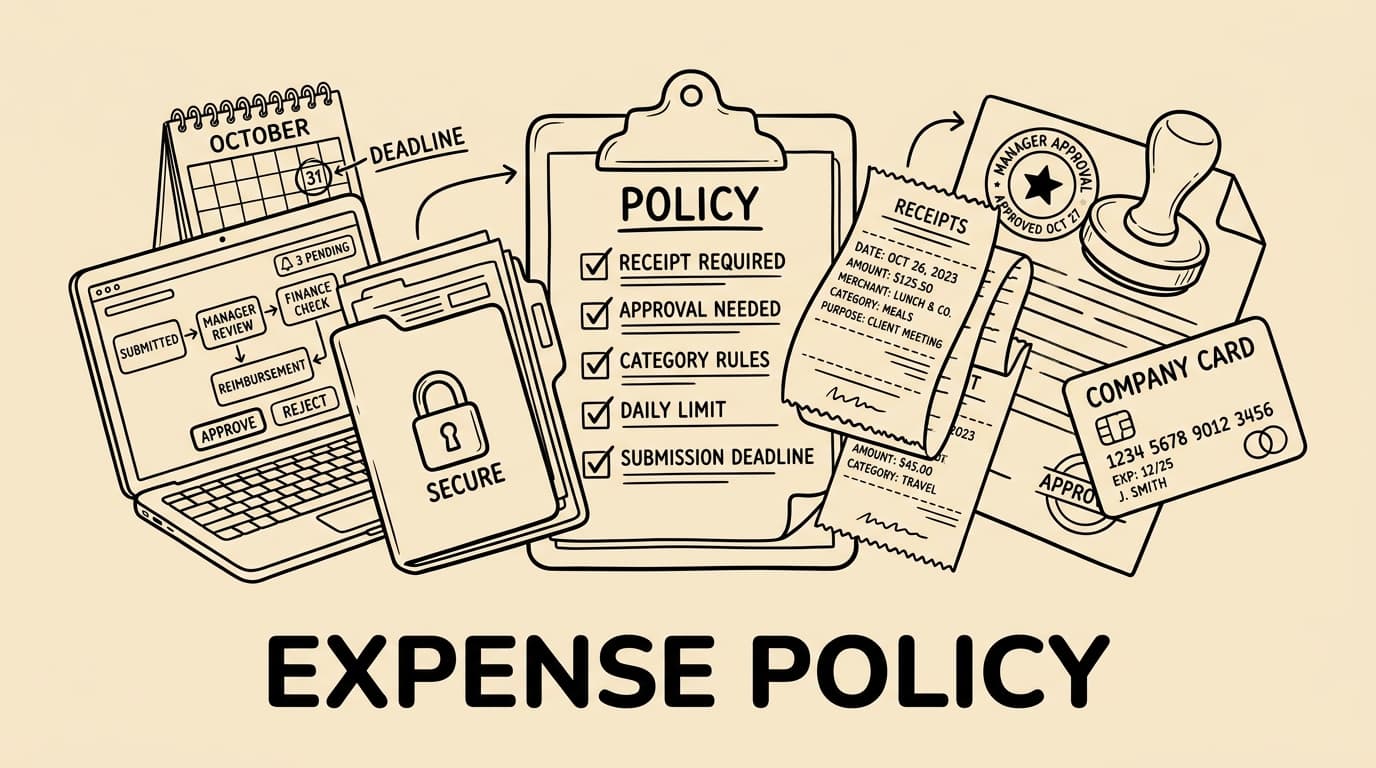
A clear employee expense policy is not a bureaucracy project; it is an operating system for everyday spending. It tells people what they can buy, which evidence is required, who approves exceptions, and how quickly reimbursement happens. Without that shared rulebook, employees guess, managers approve inconsistently, and finance spends month-end chasing missing receipts instead of closing the books.
Why an employee expense policy matters
The best policy is practical enough for a new employee to understand in ten minutes and precise enough for finance to defend during an audit. It should define roles, limits, documentation standards, approval routes, deadlines, card rules, tax-sensitive categories, and the consequences of repeated non-compliance. The aim is not to reject legitimate costs; it is to make legitimate costs easy to submit correctly.
Start with scope. Explain who the policy applies to, which entities and countries are covered, and how contractors, board members, volunteers or temporary staff are handled. Then define the core categories: travel, meals, accommodation, mileage, home office, software subscriptions, client entertainment, training, office supplies, and exceptional one-off purchases.
The policy template: sections to include
Start with scope. Explain who the policy applies to, which entities and countries are covered, and how contractors, board members, volunteers or temporary staff are handled. Then define the core categories: travel, meals, accommodation, mileage, home office, software subscriptions, client entertainment, training, office supplies, and exceptional one-off purchases.
Every category needs three things: what is allowed, what needs prior approval, and what will normally be rejected. For example, a meal policy may allow reasonable meals during business travel, require pre-approval for client entertainment above a threshold, and reject alcohol-only receipts. A software policy may allow pre-approved subscriptions but require IT or finance review before annual renewals.
- Expense policy
- Receipts
- Approvals
- Reimbursements
Receipt and documentation rules
Every category needs three things: what is allowed, what needs prior approval, and what will normally be rejected. For example, a meal policy may allow reasonable meals during business travel, require pre-approval for client entertainment above a threshold, and reject alcohol-only receipts. A software policy may allow pre-approved subscriptions but require IT or finance review before annual renewals.
Documentation rules should be written in plain language. Employees need to know which receipt is acceptable, which data must be visible, when a card statement is not enough, and how to handle lost receipts. Finance should also specify deadlines: for instance, submit expenses within thirty days, upload receipts immediately after card spend, and add business purpose and attendee details for meals or events.
Approvals, exceptions and spending limits
Documentation rules should be written in plain language. Employees need to know which receipt is acceptable, which data must be visible, when a card statement is not enough, and how to handle lost receipts. Finance should also specify deadlines: for instance, submit expenses within thirty days, upload receipts immediately after card spend, and add business purpose and attendee details for meals or events.
Approval design matters as much as the written policy. A lightweight flow might route ordinary claims to a line manager and exceptions to finance. A larger company may add project owners, budget holders or country controllers. Whatever the model, the policy should make approval criteria visible so managers do not rely on personal preference.
Use tax-neutral language for international teams and adapt thresholds to your own jurisdiction before launch.
Travel, mileage and corporate card rules
Approval design matters as much as the written policy. A lightweight flow might route ordinary claims to a line manager and exceptions to finance. A larger company may add project owners, budget holders or country controllers. Whatever the model, the policy should make approval criteria visible so managers do not rely on personal preference.
Spending limits work best as guardrails, not traps. Publish realistic thresholds for hotels, meals, taxi use, mileage, rail, flights and incidental costs. Add examples for high-cost cities, conferences, emergency travel and customer meetings. If a limit must be exceeded, require a note before the purchase whenever possible and a documented reason afterwards.
Rollout plan for finance teams
Spending limits work best as guardrails, not traps. Publish realistic thresholds for hotels, meals, taxi use, mileage, rail, flights and incidental costs. Add examples for high-cost cities, conferences, emergency travel and customer meetings. If a limit must be exceeded, require a note before the purchase whenever possible and a documented reason afterwards.
Corporate card rules deserve their own section. State who can receive a card, which purchases are allowed, which purchases remain personal, how quickly receipts must be attached, and what happens if receipts are repeatedly missing. A good card policy also explains temporary limit increases, stolen cards, cash withdrawals and subscriptions charged to former employees.
Tools like Bill.Dock can turn the policy into a working approval flow: employees capture receipts, managers approve exceptions, and finance keeps a searchable audit trail.
Common mistakes to avoid
Corporate card rules deserve their own section. State who can receive a card, which purchases are allowed, which purchases remain personal, how quickly receipts must be attached, and what happens if receipts are repeatedly missing. A good card policy also explains temporary limit increases, stolen cards, cash withdrawals and subscriptions charged to former employees.
Rollout should be treated as change management. Publish the policy, provide a one-page checklist, run a short training for managers, and show employees two or three examples of correct submissions. Keep the first month focused on education rather than punishment, then use reports to identify departments where rules are unclear or tools create friction.
FAQ
How long should an employee expense policy be?
Most companies can cover the essentials in four to eight pages plus a one-page quick guide. The goal is clarity, not legal density.
Should every expense need manager approval?
Usually no. Low-risk categories can be automated or sampled, while exceptions, high values and unusual categories should be reviewed.
What if an employee loses a receipt?
Define a lost-receipt declaration with business purpose, amount, date, merchant and manager confirmation. Repeated use should trigger review.
How often should spending limits change?
Review them at least twice a year and whenever travel costs, inflation or company policy changes make current limits unrealistic.
Conclusion
The practical test is simple: can an employee decide what to do before spending money, can a manager approve consistently, and can finance explain the decision six months later? If the answer is yes, the policy is doing its job. If not, the template needs more examples, clearer thresholds or a better workflow.
Policy checklist / Kontrollliste / Checkliste
| Area | Rule to define | Evidence |
|---|---|---|
| Receipts | Required fields and deadline | Original receipt or approved declaration |
| Approval | Manager, finance, budget owner | Workflow timestamp and reason |
| Cards | Allowed spend and missing receipt process | Card transaction plus receipt |
| Travel | Class, booking channel, exceptions | Itinerary, invoice, business purpose |
Practical example
Example: an employee books a late train after a customer meeting, uploads the ticket, adds the project code and explains why the normal fare limit was exceeded. The manager can approve based on context, and finance can still see the audit evidence later.
Tools like Bill.Dock can turn the policy into a working approval flow: employees capture receipts, managers approve exceptions, and finance keeps a searchable audit trail.
Practical example
Example: an employee books a late train after a customer meeting, uploads the ticket, adds the project code and explains why the normal fare limit was exceeded. The manager can approve based on context, and finance can still see the audit evidence later.
Tools like Bill.Dock can turn the policy into a working approval flow: employees capture receipts, managers approve exceptions, and finance keeps a searchable audit trail.
Practical example
Example: an employee books a late train after a customer meeting, uploads the ticket, adds the project code and explains why the normal fare limit was exceeded. The manager can approve based on context, and finance can still see the audit evidence later.
Tools like Bill.Dock can turn the policy into a working approval flow: employees capture receipts, managers approve exceptions, and finance keeps a searchable audit trail.
Implementation checklist for managers
Managers should apply the policy consistently rather than asking finance to decide every small question. Before approving, check the business purpose, category, date, receipt quality, amount, budget owner and any exception note. If the claim is unusual but legitimate, approve it with a short explanation so the audit trail shows why the decision was reasonable.
Finance should review patterns monthly: late submissions, repeated missing receipts, duplicate merchants, card spend without projects and categories with many exceptions. These reports reveal whether the policy is unclear, whether limits are unrealistic, or whether a team needs training.
Implementation checklist for managers
Managers should apply the policy consistently rather than asking finance to decide every small question. Before approving, check the business purpose, category, date, receipt quality, amount, budget owner and any exception note. If the claim is unusual but legitimate, approve it with a short explanation so the audit trail shows why the decision was reasonable.
Finance should review patterns monthly: late submissions, repeated missing receipts, duplicate merchants, card spend without projects and categories with many exceptions. These reports reveal whether the policy is unclear, whether limits are unrealistic, or whether a team needs training.